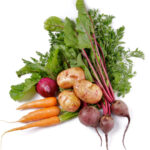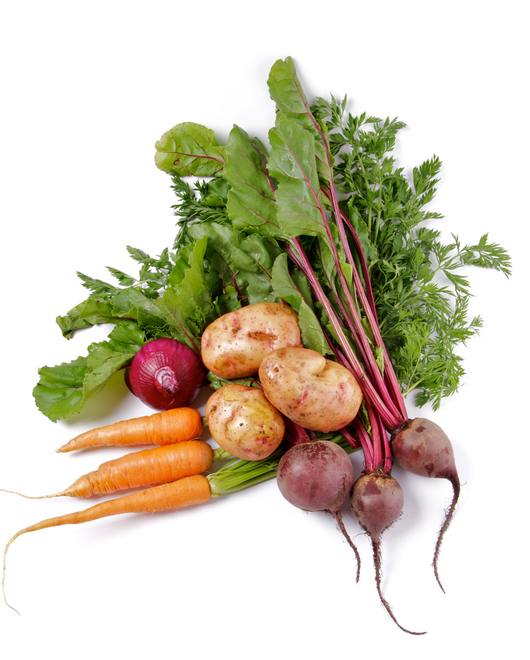
Growing root vegetables means borrowing a pantry the plant packed for itself. We just get there first.
A carrot isn’t trying to feed you, it’s trying to feed next year’s plant. Most of the vegetables we lump together as “root vegetables” are biennials or perennials. They spend their first season storing starch and sugar underground so they can survive the winter and flower the following year. We harvest them at peak storage, before they can spend it.
Not all of them are roots, strictly speaking. Potatoes and sunchokes are swollen underground stems called tubers. Celeriac and much of the bulb of a beet are hypocotyl, the stretch of stem between the root and the first leaves. The plant doesn’t care what we call them, and neither does the soup pot. What they share is a talent for keeping, which made them the backbone of the winter diet long before refrigerators.
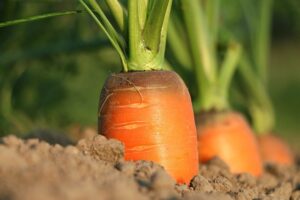 Carrot
(Daucus carota subsp. sativus)
The first domesticated carrots were purple and yellow, grown from western to central Asia in the early Middle Ages. The orange carrot came later. It was probably selected in western Europe around the Renaissance, and it took three recessive genes working together to produce its high levels of alpha and beta carotene. The carrot has even left its name on chemistry: carotene is named after it, and the whole carotenoid family is named after carotene.
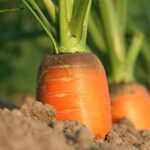
The carrot you eat is the seedling’s first root, thickened, and it needs to travel straight down. A Finnish study found that compacted soil produced short, deformed, cone-shaped carrots. Stones and hard lumps cause the same trouble, so deep, loose, stone-free soil matters more for carrots than for almost any other crop.
The seed is tiny, which is why you’ll find it sold as seed tape or pellets. An old market garden trick is to sow a few fast radishes in the carrot row. They mark the row, break the surface crust, and come out for the salad bowl just as the carrots get going.
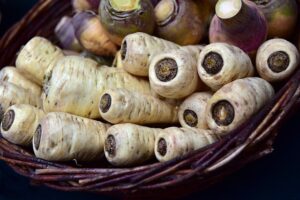 Parsnip
(Pastinaca sativa)
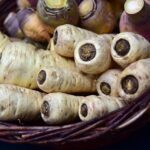
Parsnips reward patience twice. The first time is at sowing: the seed is slow to sprout in cool soil, often taking three weeks or more. The seed is also short-lived, so last year’s packet often gives patchy germination or none at all. Buy fresh seed each spring and sow directly in the garden, because parsnips (like most root crops) resent transplanting.
The second reward comes at harvest. Cold turns parsnip starch into sugar. In one Canadian study, roots held at 0 Celsius lost starch and gained sucrose, fructose and glucose, and they sweetened faster at 0 Celsius than at 10 Celsius. This is why gardeners wait for frost before digging. In milder regions, you can leave a few in the ground to dig in spring. On the Prairies and in other cold regions it’s a gamble, but a thick blanket of straw or leaves over the row improves your odds.
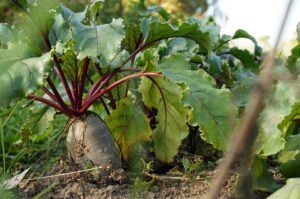 Beet
(Beta vulgaris)
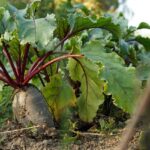
Beets are a two-for-one: roots and greens. If you want both, take only one or two outer leaves per plant and leave the centre rosette alone, because those leaves are what feed what’s below the ground.
Their colour comes from betanin, which is approved as a food colourant (E162 on ingredient labels). Contrary to its reputation, betanin is sensitive to heat, light and oxygen, and it fades with cooking and processing. That’s why roasted beets look a bit less vivid than raw ones, and why beet red is used mostly in foods that aren’t heated much.
What looks like a beet seed is really a seed ball: two to five fruits fused into one corky cluster, each holding its own seed. Sow one “seed” and you may get a small crowd, so thinning is part of the deal. Plant breeder V.F. Savitsky found a single-seeded (monogerm) beet in 1948, and monogerm table beets such as ‘Moneta’ and ‘Solo’ are now available for gardeners who would rather not thin.
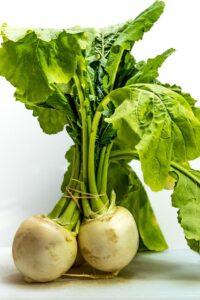 Turnip
(Brassica rapa subsp. rapa)
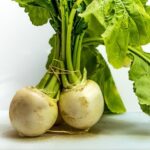
Turnips grow partly out of the ground, with their shoulders exposed as the root swells. In sunlight those shoulders often turn purple, which is exactly where purple-top varieties get their name. It’s cosmetic. If you’d rather have an all-white turnip, pull a little soil up over the tops.
Harvest them young, around golf-ball size, for a tender, mild root. Large, old turnips are where the vegetable earned its reputation.
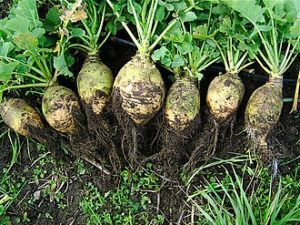 Rutabaga
(Brassica napus var. napobrassica)
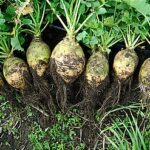
The rutabaga is a hybrid of a turnip and a cabbage. Japanese-Korean botanist Nagaharu U worked out this ancestry in 1935, and the diagram of Brassica relationships he drew (the “Triangle of U”) is still in textbooks. You can taste both parents in it.
Rutabagas are cold-tolerant and keep for months. Researchers at the University of Guelph found that their sugar content climbed during the first two weeks of cold storage, and that plants given a long cold spell had about 10 percent more sugar. That’s a nice bonus.
The biggest risk in storage is drying out. The grocery store answers that with a coat of paraffin wax. At home, keep them cold and humid. Canadian researchers found that rutabagas stored at high humidity lost far less weight and quality, and in a Slovenian study, roots held at 0 Celsius for four months stayed in good shape and ended up about a quarter sweeter than at harvest. A crisper drawer or a bin of damp sand in a cold room will do the job.
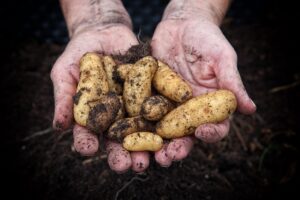 Potato
(Solanum tuberosum)
Few crops have shaped history like the potato. By 1845, an estimated 40 per cent of Ireland’s population lived mainly on potatoes, eaten with buttermilk, water, fish or whiskey. An adult labourer could get through around 12 pounds a day. Then late blight arrived, and yields fell by a third in 1845 and by three-quarters in 1846. The real Phytophthora infestans, which causes late blight, is a water mould.
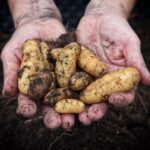
For gardeners, potatoes are still one of the most reliable staples. Plant them as soon as the soil can be worked, and hill soil around the stems as they grow so the developing tubers stay covered. Light turns tubers green, which is not good. Green in the tuber signifies raised levels of the glycoalkaloids solanine and chaconine, which are bitter and toxic in quantity. Cut away small green patches generously or compost the tuber.
New potatoes are ready in about 70 days. For storage, let them grow on until they’ve been in the ground for around 100 days or wait until the vines have died back. Then cure them for two weeks somewhere dark, humid and moderately cool (roughly 10 to 13 Celsius) so small wounds can heal over before storage. After that, store them in the dark at around 8 to 10 Celsius. Colder is not better: below about 8 Celsius, potatoes turn starch into sugar, which tastes odd and makes fries brown too fast. Seed potatoes are the exception and can go colder.
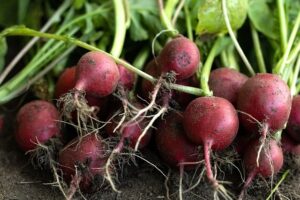 Radish
(Raphanus sativus)
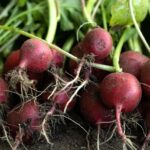
Radishes are the sprinters of the vegetable garden. Varieties like ‘Cherry Belle’ and ‘Sparkler’ go from seed to salad in about a month. Their bite comes from mustard oils (isothiocyanates) that form when you chew and break the cells open.
Heat and drought are what ruin them: the roots turn pithy, woody or hollow, and the plants bolt. Heat alone doesn’t make them hotter, though. An Australian study of daikon (long white Japanese radish) found them most pungent in spring and autumn and mildest in summer and winter. Pull spring radishes promptly, because a radish left too long goes spongy long before it goes sweet.
Long-season types such as daikon, which can easily top 14 inches, and black Spanish radishes need two months or more. Cold nights and long days both push radishes to flower, so an early spring sowing gets a double push toward bolting. Where autumn is long, sow in late summer for a fall crop. Where it isn’t, sow in early to mid July, once the days have started to shorten, or choose a bolt-resistant spring daikon and sow it after the soil warms. A light frost won’t hurt them.
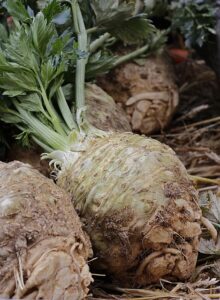 Celeriac
(Apium graveolens var. rapaceum)
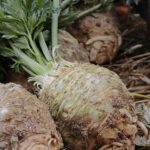
Celeriac is a form of celery grown for its swollen base rather than its stalks. It is gnarled and frankly homely, but it has a clean celery and parsley flavour that French cooks have long prized. It’s a bit fussy, but people who love it grow it anyway.
It needs 110 to 130 days from transplant, so start it indoors about 10 weeks before your last frost. Germination is slow and uneven; don’t give up on it. Don’t rush it outdoors either. Once young celeriac plants are past the seedling stage, a long spell of cool temperatures can trigger flowering, and a plant that bolts puts its energy into seed instead of the root , leaving you with a small, woody knob better suited to the stockpot than the plate. Transplant after the nights have settled.
Keep it evenly watered, because drought gives you a small, stringy root. Late in the season you can strip a few lower leaves to tidy up the bulb. Harvest before a hard freeze and store it at 0 to 2 Celsius with high humidity, where it will keep for months.
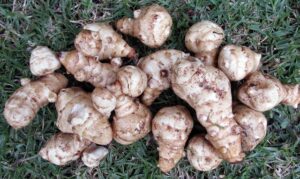 Jerusalem artichoke
(Helianthus tuberosus)
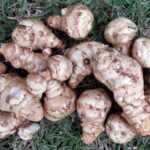
It’s not from Jerusalem and it’s not an artichoke. It’s a North American sunflower, and Indigenous farmers in eastern North America were growing it thousands of years before European contact. We know this partly thanks to a fly. Strauzia longitudinalis can live only on sunchoke, so its genes carry the plant’s history with it. They show sunchoke spreading west from the Ohio Valley over the same centuries that Indigenous agriculture took hold in the region. The knobby tubers are crisp and nutty, and they’re also sold as sunchokes.
Instead of starch, the tubers store inulin, which makes up most of their dry matter. Our digestive enzymes can’t break inulin down, so it passes to the large intestine, where gut bacteria ferment it. The bacteria are happy. Your dinner guests may be less so. Cooking helps, but not in the way you might expect. Plain boiling does almost nothing, because inulin survives boiling in plain water. Heat it in acidic conditions, though, and it breaks down readily, so a generous hit of lemon juice or vinegar in the pot may earn its keep. Roasting in a hot oven may help a little too, mostly in the crisp, browned outer layer, where the tuber has dried out and gets much hotter than boiling water. Small portions remain the surest fix.
Choose the planting spot carefully. The species is a vigorous perennial, and in some regions it’s listed as an invasive weed. Every fragment of tuber you miss at harvest comes back next year. Many gardeners give it a bed of its own. Plant tubers in spring in full sun, 2 to 4 inches deep and 12 to 16 inches apart. They tolerate poor soil but grow best with steady moisture.