

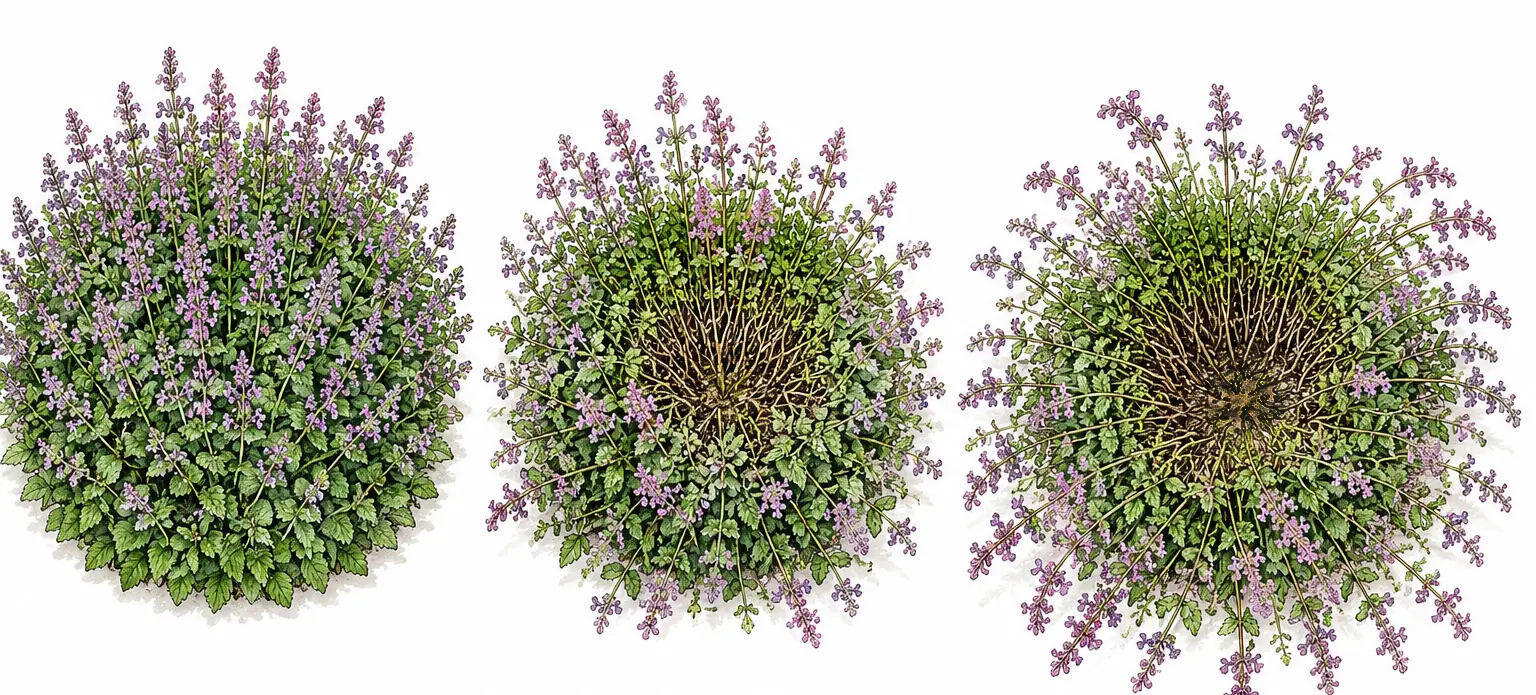
Why some perennials die in the middle
Many gardeners wonder why some of their perennials, after a couple of years, start behaving differently. It’s called the donut effect: the centre dies down and the surrounding flowers lean outward. It looks like a big fat cat has sat in the middle of your plant, but it is a sign that a perennial has aged enough to lose vigour in its centre while continuing to grow outward.
Clump-forming perennials like Shasta daisies, coneflowers and catmint, expand by producing new shoots around the crown each year. The crown is where the roots and stems meet, and when the plant is young, it is dense with living tissue. Over time, many clump-forming perennials become crowded at the crown. The oldest tissue in the centre may turn woody, die back, or become less productive, while the youngest shoots continue to form around the outside edge. Fine feeder roots are renewed, but the older central crown often does not rebuild itself into fresh, vigorous growth. The result is a living outer ring around a tired or dead centre.
As the plant expands, the youngest and most vigorous growth occurs around the perimeter. The plant has no easy way to reclaim the space occupied by ageing crown tissue, so it simply grows around it. The hollow centre you see above ground is often a reflection of these changes below ground.
Why the plant flops outward
Once the central crown declines, the plant’s architecture changes. Each year’s new shoots emerge from the outer rim, where they have room to expand. Their bases are angled slightly outward, and there is no longer a dense living centre to help support them. When the stems lengthen and bloom, gravity, wind and rain can pull them down. The clump spreads outward like a wheel that has lost its hub. Shasta daisies, rudbeckia, monarda and nepeta are especially prone to this collapse.
Division is your way of resetting the plant. In nature, disturbances sometimes break apart older crowns and create opportunities for younger sections to continue growing independently. Lifting and splitting the plant removes the ageing centre and restores vigorous growth. Each new division has a fresh, living crown surrounded by active roots that can efficiently take up water and nutrients. Once replanted, the stems often grow more upright and flowering improves.
How to divide
For most clump-forming perennials, dividing every two or three years is good. Do it in early spring when the first green shoots appear, or in early autumn while the soil is still warm. Lift the clump with a fork, shake off the soil, cut it into vigorous sections, and replant the outer pieces. Water well and mulch lightly.
Shasta daisies are the classic example, but the same process affects asters, bee balm, garden phlox, blanket flowers and black-eyed Susans. Even ornamental grasses such as miscanthus can develop a dead centre over time. In each case, the underlying cause is similar: the most vigorous growth shifts outward while the oldest central tissue declines.
Ignoring the donut effect often means fewer flowers, weaker growth and a less attractive plant. By splitting the clump apart, yesterday’s outer edge becomes tomorrow’s centre. Plus, it yields extra plants to share or fill in other spots in the garden. It is a simple task that restores both the appearance and vigour of the plant, setting it up for years of healthy growth.