
Does overhead watering really cause disease?
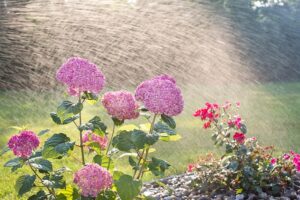
Gardeners are often warned never to water plants from overhead because wet leaves supposedly encourage disease. There is truth to this advice, but the science is more nuanced than many gardening books suggest.
After all, nearly all outdoor plants evolved with rain falling directly onto their foliage. In nature, leaves are regularly wetted by rain, dew and fog.
How long are plants wet?
Plant pathologists are less concerned with water itself than with how long leaves remain wet. Many fungal diseases need extended periods of moisture to infect plants successfully.
For roses, diseases such as black spot become much more likely when foliage stays damp for many hours, especially during warm, humid weather. A humid evening watering in southern Ontario may leave leaves wet overnight, creating ideal conditions for infection. By contrast, overhead watering on a sunny, breezy prairie morning may allow foliage to dry quickly and cause few problems.
Air circulation, humidity, plant spacing and climate all matter. A crowded rose bed with poor airflow is far more likely to develop fungal problems than an open, breezy planting.
When you water matters as well. If overhead watering is used, morning is generally considered the safest time because foliage has a chance to dry during the day.
Difference in diseases
Interestingly, not all diseases respond to water in the same way. Powdery mildew, for example, often spreads during humid conditions without free water sitting on leaves and may actually be suppressed somewhat by direct washing.
Another overlooked factor is breeding. Many modern roses have been selected heavily for flower form and colour rather than disease toughness. Hardier shrub roses and wild species are often more tolerant of wet conditions.
The best scientific conclusion is not that overhead watering is always harmful. Rather, prolonged wet foliage under humid conditions can increase disease risk, especially on susceptible plants.
So, should you always water at the base?
Hold on. Depending on the situation, watering at the base can be problematic:
Overwatering the root zone
People sometimes hear “don’t wet the leaves” and compensate by soaking the soil constantly. That can lead to root rot, oxygen deprivation and stressed roots, especially in heavy clay soils common in parts of Canada.
Poor root distribution
Frequent shallow base watering can encourage shallow rooting. Plants may become more drought-sensitive because roots stay near the surface instead of exploring deeper soil.
Humidity near the crown
Dense drip irrigation or crowded mulch around the base can actually increase humidity around lower stems and crowns. Some crown rots and stem diseases thrive in these stagnant conditions.
Salt buildup
In dry climates, exclusive drip or base watering can contribute to salts accumulating near the root zone because foliage and surrounding soil are never flushed naturally by rainfall or overhead irrigation.
Uneven watering
A narrow drip zone may not fully wet the actual root area, especially for mature shrubs and trees whose roots extend far beyond the trunk or crown.
Hot weather stress
Occasional overhead irrigation can cool foliage and reduce heat stress in some situations. Commercial nurseries sometimes deliberately use overhead misting or syringing during heat events.
Mites and dust
Dry foliage can favour some pests, particularly spider mites. In greenhouses and arid climates, periodic overhead washing is sometimes used to suppress mite populations.
Hydrophobic soil
Very dry peat-based or organic soils may repel water when watered gently at the base. Overhead soaking or broad irrigation can sometimes re-wet the soil more effectively.
Think about nature. Natural ecosystems are not drip irrigated. Most plants evolved under broad-area wetting from rain, snowmelt and seasonal saturation patterns. Plants are generally adapted to cycles of wetting and drying across entire soil profiles, not just constant moisture at one tiny point.