

People tend to learn Canada thistle by touch. One brush against a prickly leaf and suddenly it has a permanent place in memory.
It is familiar enough that most of us assume the name explains it. It does not. Canada thistle is neither Canadian nor an ordinary weed. The plant you see above ground is only the visible part of a much larger operation underground.
Canada thistle succeeds, like a lot of weeds, because it runs two systems at once. It spreads by seed and it also builds a long-lived network of roots that stores energy and sends up new shoots. Once you understand that, the control strategy becomes much clearer.
The job is not to win one heroic pulling session. It is to stop seed production, repeatedly drain the root reserves and give more desirable plants the open ground before thistle takes it again.
1. The name is a fib
Canada thistle, Cirsium arvense, is native to Europe and temperate Asia. It has spread widely across North America and now occurs in every province and territory except Nunavut.
The name is unfortunate, but it has stuck. “Creeping thistle,” another common name, is more revealing. The plant creeps through the soil, often far beyond the stems you can see.
The Canadian Food Inspection Agency classifies Canada thistle seed as a Class 2 noxious weed seed. That classification is about commercial seed standards, but it gives you a sense of the plant’s reputation. This is not a charming wildflower that happens to have sharp elbows.

2. That patch may be one plant
A thistle patch can look like a crowd of separate plants, but often it is really one clone with many shoots connected by an underground root system.
Those roots are not just plumbing. They are storage organs, packed with the carbohydrates that allow the plant to recover after cutting, pulling or winter.
Research from the University of Alberta showed just how quickly the system can develop. Under field conditions, 18-week-old plants averaged 26 aboveground shoots, 154 underground shoots and 360 feet of root.
That explains why removing the stem you can see is rarely the end of the story.
3. The roots do the local work
A female flowerhead can produce dozens of seeds, each fitted with a pale tuft of hairs called a pappus. When the heads turn fluffy, the plant has reached the stage where it can send offspring away by wind, water, soil movement or contaminated materials such as straw and manure.
But the root system drives the local takeover. It sends up shoots some distance from the original stem, making the patch grow outward even when no seed is involved.
You can and should remove the flowers, but that won’t make the plant disappear.
4. Its flowers have separate sexes
Canada thistle usually has male and female flowers on separate plants. Pollinating insects move pollen between them and seed production requires male and female plants close enough together.
A patch that began from one plant may be a clone of one sex. It may therefore spread for years through its roots without producing any viable seed at all. A male or female colony can still send up a formidable number of shoots.

5. It has a scent that insects adore
Canada thistle flowers have a surprisingly strong fragrance. Studies of their floral scent have found compounds that attract pollinators and insects that feed on flowers.
Bees, hover flies, wasps and other insects may visit a patch with great gusto. It is one of the reasons this plant can create a moment of confusion for gardeners trying to do the right thing for pollinators.
The answer is not that every plant visited by a bee deserves permanent residency. A dense Canada thistle stand can crowd out a varied community of flowering plants, including native species that would otherwise support insects through a longer season.
It is possible to recognize that Canada thistle offers nectar and still decide that it does not belong in the middle of your garden.
6. Not every thistle is the villain
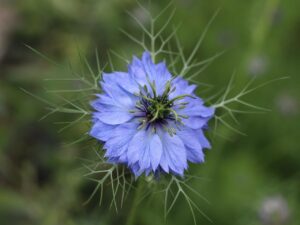
Canada has native thistles, and several are useful wildlife plants. They provide nectar and pollen, and their seeds can feed birds. A prickly purple flower is not enough evidence to condemn a plant. (See the gallery below for native thistles.)
Canada thistle usually forms a spreading colony rather than standing alone. Its flowerheads are relatively small and appear in clusters, usually pink to purple. Its flowering stems do not have the conspicuous prickly wings found on some other thistles.
The leaves are prickly and variable, so they are not the best single clue. If you are dealing with an isolated thistle in a naturalized garden, prairie planting or rural property, identify it before removing it.
A clear photograph of the whole plant, including the flowerheads, stem and leaf undersides, is much more useful than a close up of one flower. Thistle identification is not the moment for a snap verdict.

7. Rototilling can make it worse
Canada thistle can regenerate from pieces of root. A field study found that cut root fragments could produce new shoots, sometimes only about a centimetre long. Whether a fragment succeeds depends on its size, depth and moisture, but rototilling an established patch can certainly turn one problem into several.
For a small new infestation, digging is still worthwhile. Use a digging fork, remove as much of the root as you reasonably can, and expect to return when new shoots appear.
The point is not to excavate to the centre of the Earth. It is to remove root material, watch carefully and prevent every surviving piece from rebuilding its reserves.
8. Try mowing
Cutting Canada thistle works (eventually) because every new shoot needs energy from the roots to grow. If you remove shoots repeatedly, before they can build a useful leaf canopy, the plant has to keep spending its savings.
Research and extension guidance suggest repeating shoot removal about every 21 days through the growing season. Cut early growth and never allow flowerheads to mature into seedheads. It takes one or two years, so be patient. Larger colonies can take four or more years.
In a lawn, mowing is the obvious tool. In a garden bed, cut stems close to the ground and remove individual shoots as they return. If seedheads have begun to turn fluffy, bag them and follow local waste guidance rather than trusting an ordinary backyard compost pile with the job.

9. A brown top is not a dead thistle
A flame weeder, vinegar-based product or contact herbicide may scorch the leaves and make Canada thistle look thoroughly defeated. If the roots survive, though, the plant has only lost a stem.
For an old, established patch, a systemic herbicide, can be the more practical tool because it moves from treated green leaves into the root system. It is generally most useful when the plant is actively growing, especially in late summer or fall.
Apply it precisely, avoid drift and expect follow up in later seasons. Canada thistle is persistent enough that a second year of treatment is a normal part of the plan, not proof that you did it wrong.
10. Replace the gap it leaves
Canada thistle thrives where soil has been disturbed and desirable plants are thin. Once you weaken or remove it, do not leave a vacancy with its name on it.
In a lawn, restore dense turf by keeping the grass watered and healthy. In a garden bed, replant the cleared space with plants suited to the light, soil and moisture there.
Competition will not erase a mature Canada thistle colony by itself. It does make life more difficult for seedlings and weakened regrowth, particularly after you have spent a season draining the roots.
The practical plan is simple. Stop seedheads from forming. Keep cutting new shoots. Use a carefully targeted systemic herbicide if an established patch needs one. Replant the opening.
Canada thistle is not a weed you defeat with one grand gesture. It is a weed you outlast.