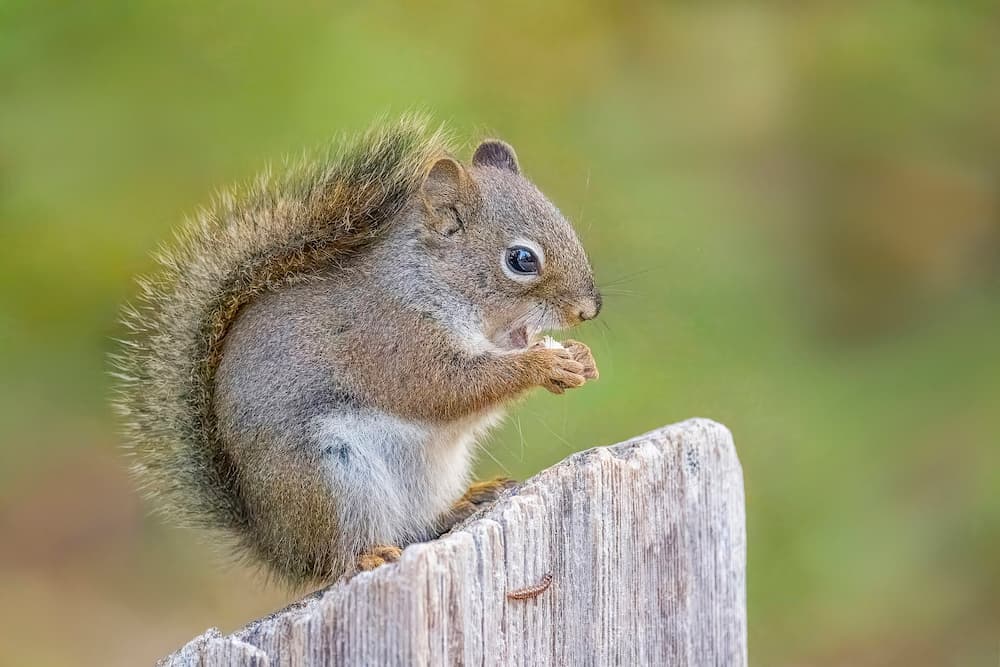
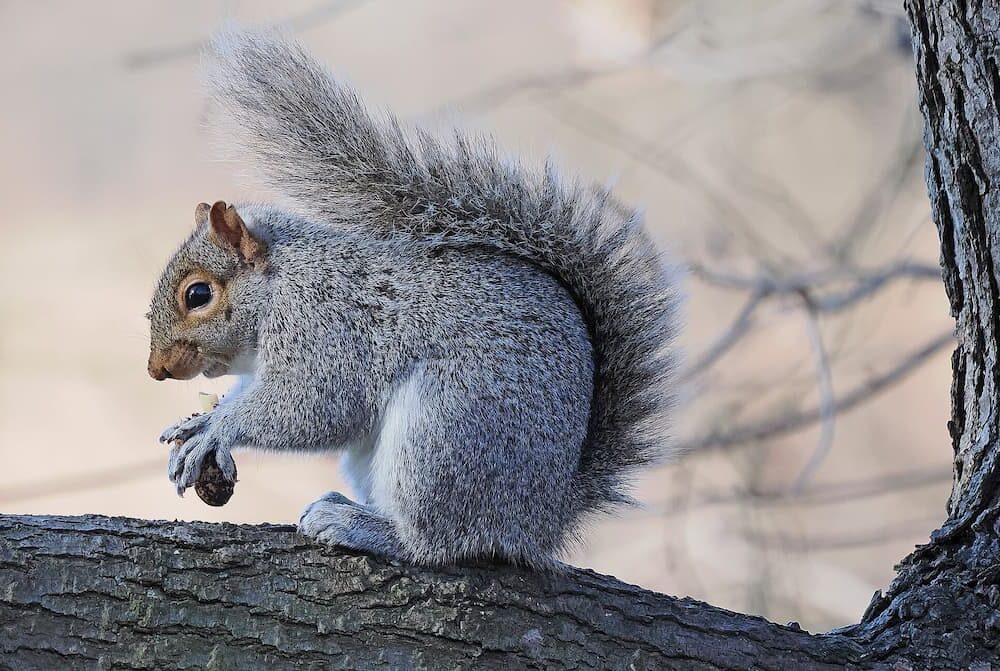

Squirrels are the most familiar wild mammals in many Canadian yards, and among the least appreciated. Behind the tulip thievery is an animal with a remarkable memory, a sophisticated approach to food storage and a few habits that still puzzle the scientists who study them.
But first…
Red or grey? Know your squirrel
They share a backyard name, but red and grey squirrels belong to different genera and live very different lives.
Red squirrel (Tamiasciurus hudsonicus)
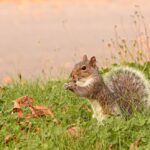
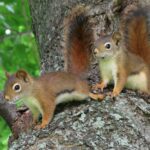
The smaller of the two, with a rusty back and a white belly. Found coast to coast and far into the North, mostly in conifer forests. Each red squirrel claims a territory and defends it noisily. It stores its food in one place: a midden, a heap of cones and discarded scales it guards all winter.
Grey squirrel (Sciurus carolinensis)
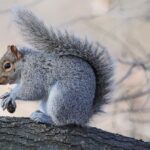
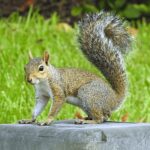
Noticeably bigger, and despite the name, its coat may be grey or black. Native to the hardwood forests of southern Ontario and Quebec, and very much at home in towns and cities. In British Columbia it’s an introduced species: grey squirrels were released in Vancouver in 1909 and near Victoria in 1966, and have since spread through residential areas. Rather than keeping one pile, a grey squirrel buries nuts one at a time across a wide area, which is why memory and fake caches matter so much to it.
And the others
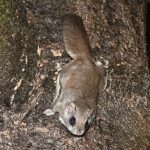
Flying squirrels are a third group altogether: nocturnal gliders seldom seen by day. And the red squirrel of British fame is a different species again, the Eurasian red squirrel, not our own.
1. Grey squirrels find their buried nuts by memory, not just by smell
For a long time, people assumed squirrels relocated buried nuts by sniffing them out. In one experiment, grey squirrels recovered more of their own caches than caches buried by other squirrels, even though all the nuts smelled the same. In a field study in England, grey squirrels returned to within 5 cm of a buried treat about 60 percent of the time after 20 days, and at least one still remembered a location after 62 days. They navigate by nearby landmarks; smell helps them close the final gap.
2. Red squirrels steal from their neighbours, but Yukon red squirrels rarely do
Red squirrels store cones in one big pile called a midden, which makes a tempting target. In one study, almost every squirrel stole from its neighbours and almost every squirrel was robbed, losing about a quarter of its stash. Squirrels with small middens came out ahead and those with large middens lost ground. In Yukon’s Kluane region, however, only about one squirrel in seven ever pilfered, and stolen cones made up less than one percent of the stores. The thieves there were mostly young squirrels with small larders, and they were less likely to survive the winter.
3. Grey squirrels fake burying nuts when someone is watching, including people
When grey squirrels know they’re being watched, they dig a hole, pretend to drop in a nut, cover it and walk off with the nut still in their mouths. In one experiment, researchers posed as thieves and raided the squirrels’ caches. The squirrels responded by faking more burials, hiding nuts out of sight of the humans or eating them on the spot. Whether they watch gardeners plant tulip bulbs has never been studied, though many of us have our suspicions.
4. Grey squirrels perform surgery on acorns, and some oaks outsmart them
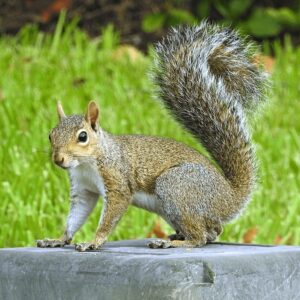
White oak acorns sprout in autumn, so they spoil in storage. Red oak acorns stay dormant until spring. Grey squirrels often eat white oak acorns right away and bury the red ones. When they do store a white oak acorn, they often bite out the embryo at the tip so it can’t sprout. Some oaks have a workaround: acorns with extra seeds or an embryo in an unusual position can survive the operation and grow anyway.
5. Black squirrels are grey squirrels built for winter
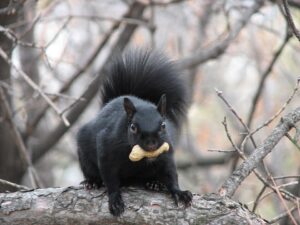
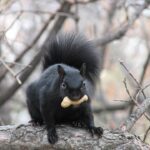
Black squirrels aren’t a separate species, just grey squirrels with a pigment mutation, and they’re common in Ontario and Quebec. All grey squirrels are cold-weather champions, able to raise their metabolism to more than 13 times its resting rate, mostly by shivering. It’s one of the highest outputs recorded in a warm-blooded animal. In winter, black squirrels have an extra edge: at −10 Celsius they lose an estimated 18 percent less heat than grey ones and can produce more heat without shivering. That may help explain why black squirrels become more common farther north. Their distribution can also be surprisingly local. A McGill student cycled to nearly 200 Montreal parks, counted more than 800 squirrels, and found that tree cover and even rivers influence which colour dominates from one neighbourhood to the next.
6. Red squirrels breed more in anticipation of a bumper spruce seed crop
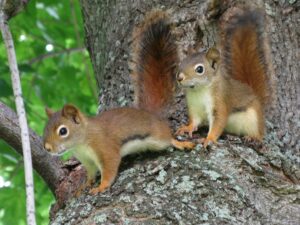
In the Yukon, red squirrels produce more litters in years when white spruce trees are about to release a huge seed crop, even though the seeds won’t be available until later that year. They breed ahead of the feast rather than in response to it, so their young emerge just as food becomes abundant. Exactly what cue tips them off is still an open question.
7. Solitary red squirrels adopt orphans, but only relatives
Red squirrels live alone and defend their territories fiercely. Yet in nearly 20 years of tracking thousands of litters in Yukon’s Kluane region, researchers recorded five cases of mothers adopting orphaned pups, and every adopter was a relative. A mother already nursing a large litter would only take in a very close relative, such as a grandchild or younger sibling, while one with a small litter might accept a niece or nephew.
8. Red squirrels tap sugar maples and come back for the syrup
Red squirrels bite through the bark of sugar maples, let the sap run, and return once the water has evaporated to lick up the concentrated sugar left behind. Like human sugar makers, they choose sugar maples almost exclusively, check their taps early in the day and work only on the warm days of late winter and early spring when the sap is running.
9. Flying squirrels glow pink under ultraviolet light, and the cause is still unknown
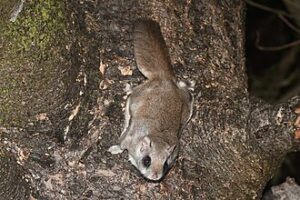
Under ultraviolet light, the fur of North American flying squirrels glows bright pink, most intensely on the belly and tail. A forestry professor discovered this by accident while scanning his backyard for fluorescent lichens and lighting up a flying squirrel at his bird feeder. All North American flying squirrels do it, including the northern flying squirrel found across Canada; red and grey squirrels don’t. A team at Trent University in Peterborough, Ont., analyzed the fur chemistry and found no compound unique to flying squirrels, suggesting the responsible pigment may be present in ordinary squirrel fur too. Why it shows up only in flying squirrels, and whether it serves any purpose, remains a mystery.
10. Grey squirrels eavesdrop on relaxed bird chatter to judge whether it's safe
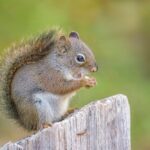
Many animals react to other species’ alarm calls. Grey squirrels also listen for the absence of alarm. When researchers played a hawk call to squirrels and followed it with the casual contact calls songbirds make when all is calm, the squirrels stopped scanning the sky and resumed foraging much faster than squirrels who heard only background noise. The birds aren’t warning anyone; the squirrels are reading the mood of the neighbourhood.
Images


Sources
Boutin, S., L.A. Wauters, A.G. McAdam, M.M. Humphries, G. Tosi and A.A. Dhondt. 2006. Anticipatory reproduction and population growth in seed predators. Science 314: 1928–1930. Using long-term data from Yukon red squirrels and European red squirrels, this study showed that squirrels increase reproduction before a mast seed year rather than after it, so their populations grow in step with the food supply.
Dinh, F.Q., I.C. Richmond, A.P. Hendry and A.M. Roth. 2026. Fine-scale spatial variation in eastern grey squirrel melanism across a complex urban landscape. Journal of Animal Ecology. A McGill University survey of grey and black squirrels in nearly 200 Montreal parks, finding that urbanization, forest canopy cover and rivers all shape where black squirrels are most common.
Donald, J.L. and S. Boutin. 2011. Intraspecific cache pilferage by larder-hoarding red squirrels (Tamiasciurus hudsonicus). Journal of Mammalogy 92: 1013–1020. A University of Alberta study in Kluane, Yukon, using marked spruce cones to track theft between neighbouring red squirrels. Only 14 percent of squirrels pilfered, and stolen cones made up 0.3 percent of stores; young squirrels with small caches were the likeliest thieves.
Ducharme, M.B., J. Larochelle and D. Richard. 1989. Thermogenic capacity in gray and black morphs of the gray squirrel, Sciurus carolinensis. Physiological Zoology 62: 1273–1292. Measured heat production in grey squirrels, which reached peak metabolic rates 13.5 times their predicted resting rate. In winter, black squirrels had 11 percent greater nonshivering heat production and an estimated 18 percent lower heat loss at −10 °C than grey ones.
Fox, J.F. 1982. Adaptation of gray squirrel behavior to autumn germination by white oak acorns. Evolution 36: 800–809. The classic study showing that grey squirrels eat autumn-germinating white oak acorns and store dormant red oak acorns, and that they remove the embryo from white oak acorns they do store.
Gerhardt, F. 2005. Food pilfering in larder-hoarding red squirrels (Tamiasciurus hudsonicus). Journal of Mammalogy 86: 108. A mark-recapture study of cached Norway spruce cones in which 97 percent of red squirrels stole and 92 percent were robbed, losing about a quarter of their stores. Squirrels with small middens gained cones overall.
Gorrell, J.C., A.G. McAdam, D.W. Coltman, M.M. Humphries and S. Boutin. 2010. Adopting kin enhances inclusive fitness in asocial red squirrels. Nature Communications 1: 22. A Canadian team from Alberta, Guelph and McGill documented five adoptions among 2,230 red squirrel litters over 19 years in Kluane. Every adoption was between relatives, and only when the benefit to the orphan, weighted by relatedness, outweighed the cost to the adopting mother.
Heinrich, B. 1992. Maple sugaring by red squirrels. Journal of Mammalogy 73: 51–54. Field observations in Maine showing that red squirrels wound sugar maples, let the sap evaporate and return to eat the concentrated sugar, working mainly on warm days in late winter and early spring.
Hughes, B., J. Bowman, N.L. Stock and G. Burness. 2022. Using mass spectrometry to investigate fluorescent compounds in squirrel fur. PLOS ONE 17: e0257156. A Trent University study comparing the fur chemistry of flying squirrels with red squirrels, grey squirrels and chipmunks. No compound unique to flying squirrels was found, suggesting the cause of the pink glow is present in ordinary squirrel fur.
Jacobs, L.F. and E.R. Liman. 1991. Grey squirrels remember the locations of buried nuts. Animal Behaviour 41: 103–110. Captive grey squirrels buried hazelnuts in an outdoor arena and later recovered more of their own caches than caches made by other squirrels, showing that memory, not just smell, guides retrieval.
Kohler, A.M., E.R. Olson, J.G. Martin and P.S. Anich. 2019. Ultraviolet fluorescence discovered in New World flying squirrels (Glaucomys). Journal of Mammalogy 100: 21–30. The original report that all North American flying squirrels fluoresce pink under ultraviolet light, based on museum specimens and live animals; other squirrel species did not.
Lilly, M.V., E.C. Lucore and K.A. Tarvin. 2019. Eavesdropping grey squirrels infer safety from bird chatter. PLOS ONE 14: e0221279. Playback experiments with free-ranging grey squirrels in Ohio showed that after hearing a hawk call, squirrels relaxed and resumed foraging faster when they heard calm songbird chatter than when they heard ambient noise.
MacDonald, I.M.V. 1997. Field experiments on duration and precision of grey and red squirrel spatial memory. Animal Behaviour 54: 879–891. Field tests in England in which grey squirrels relocated buried food to within 5 cm in 62.5 percent of attempts after 20 days, with some recall at 43 and 62 days, using nearby visual landmarks. Based on a small number of squirrels.
McEuen, A.B. and M.A. Steele. 2005. Atypical acorns appear to allow seed escape after apical notching by squirrels. American Midland Naturalist 154: 450–458. Showed that oak trees producing acorns with multiple seeds or unusually placed embryos had higher germination after squirrels notched them, suggesting a way some acorns survive embryo removal.
Steele, M.A., S.L. Halkin, P.D. Smallwood, T.J. McKenna, K. Mitsopoulos and M. Beam. 2008. Cache protection strategies of a scatter-hoarding rodent: do tree squirrels engage in behavioural deception? Animal Behaviour 75: 705–714. More than 500 field trials in Pennsylvania and Connecticut showed grey squirrels making empty deceptive caches when others were nearby. When human researchers raided their caches, squirrels increased deceptive caching, hid nuts out of view or ate them on the spot.