10 Neat Things about 

Rose Defences

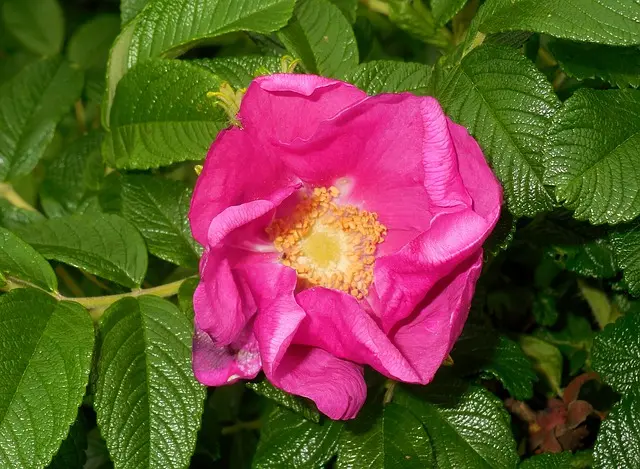
Rugosa rose

A rose can’t run away from anything, so it has spent a very long time getting good at standing its ground. Some of its defences are obvious, as anyone who has pruned a climber in short sleeves can confirm. Others are chemical, genetic or frankly sneaky.

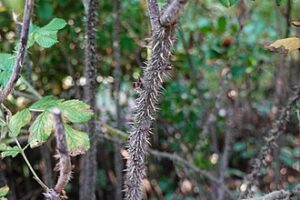
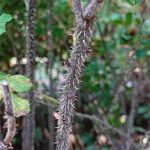
1. Roses don’t actually have thorns. What they have are prickles, and you can snap one off without hurting the stem.

Botanists sort plant points by what they’re made of. Thorns, like those on hawthorn, are modified branches. Spines, like those on cactus, are modified leaves. Both are plumbed into the plant’s veins, so pulling one off tears the plant. Rose prickles have no veins at all. They’re attached to the bark, which is why you can flick one off with your thumb and leave only a tidy little scar. Poets have called them thorns for centuries, and botanists have mostly given up arguing.

Very prickly

The standard explanation was that prickles are plant hairs that grew large and hardened. In a study published in 2021, researchers in Angers, France, surveyed the prickles on 110 roses and sorted them into types. They then used the microscope to follow prickles on a population of rose seedlings from their earliest stages. They found two kinds: glandular prickles, which carry a tiny gland on the tip when young, and non-glandular ones. Both start from cells in the layer just beneath the young stem’s skin. Plant hairs, by contrast, grow only from the skin itself. In glandular prickles, only the gland on the tip comes from the skin. Their conclusion was blunt: prickles are not modified hairs, and the mainstream idea was wrong.

Not so prickly

The same group crossed roses and counted the prickles on their offspring’s stems for three years. One region on one chromosome largely decided whether a seedling had prickles or a smooth stem. The number of prickles, though, was influenced by that region plus at least three others. Genes that control hair growth in other plants turned out to play little part, which fits with prickles not being hairs. This matters to the cut flower trade, where prickles damage blooms and injure the workers who handle them.

The same group crossed roses and counted the prickles on their offspring’s stems for three years. One region on one chromosome largely decided whether a seedling had prickles or a smooth stem. The number of prickles, though, was influenced by that region plus at least three others. Genes that control hair growth in other plants turned out to play little part, which fits with prickles not being hairs. This matters to the cut flower trade, where prickles damage blooms and injure the workers who handle them.

German researchers studied the field rose, Rosa arvensis, a scrambler that leans on other plants, alongside its cultivar ‘Splendens’. They tested how much pulling force it took to break different prickles and how the prickles failed. In the wild species, prickle tips pointed in no particular direction. In ‘Splendens’, some prickles gradually turned to point downward over their first few weeks, through uneven growth on one side. A downward hook is just the shape for catching on a branch as a long cane flops over it. The researchers assume the hooks still do double duty as defence.

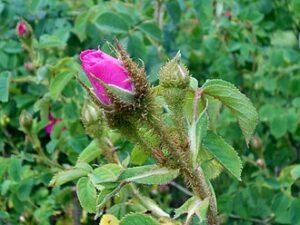
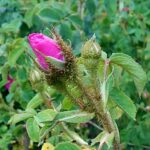
Moss roses are old garden roses that arose as sports, or bud mutations, of ordinary cabbage and damask roses. Their flower stalks and sepals are covered in a mossy growth that releases a very sticky, pine scented resin. French researchers found the moss is made of glandular hairs that sprout from other glandular hairs, the result of a mutation in the timing of hair growth. The moss is loaded with terpenes, a different chemical blend from the petals, and closely matches what the parent rose’s sepals produce. Sticky, strong-smelling buds sound like a good insect deterrent, but nobody has yet tested whether the moss actually protects them.

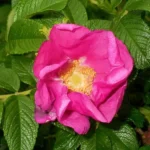
Look closely at a rugosa leaf and you’ll see glandular hairs. Japanese researchers found the resin they release is rich in a compound called rugosal A, which is strongly toxic to fungi. That’s good evidence the glands help guard the leaves. When the same team analyzed rugosa hybrids, the Explorer rose ‘Martin Frobisher’ stood out. Its leaves are densely covered with glands, but they produce almost nothing except a single, different compound. It appears to have lost the ability to make the whole chemical family that rugosal A belongs to. No published study appears to have checked whether that leaves it more open to fungal disease.

Many plants under attack release odours that attract the attackers’ enemies. Researchers tested this with roses, two-spotted spider mites and the predatory mite Phytoseiulus persimilis, which is sold for biological control. On beans and cucumbers, inexperienced predators headed straight for infested plants. On roses they couldn’t tell infested plants from clean ones. After 24 hours on infested roses, though, the predators learned and preferred infested plants afterward. They were also drawn to clean roses, which could keep bodyguards on patrol before pests arrive, or leave them hungry if pests never show up.

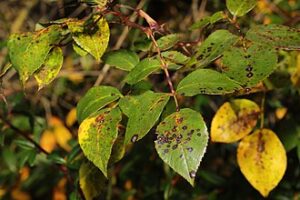
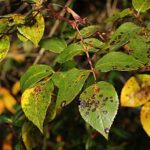
The black spot fungus comes in many strains, called races. In 1998, German researchers described the first resistance gene ever found in a rose, Rdr1, from a breeding line with Rosa multiflora ancestry. It works on a lock and key system: the rose’s gene recognizes a specific molecule from the fungus and launches a defence. A strain without the matching molecule can slip past. Later work showed the working gene sits in a cluster of at least nine very similar genes near the end of one chromosome, and that this kind of cluster existed before roses and strawberries went their separate ways. The cluster holding the working gene has evolved faster than its neighbour, as you might expect in a long-running contest with a fungus.

American researchers mapped a separate resistance gene, Rdr3, in the Explorer rose ‘George Vancouver’ and developed a DNA test so breeders can stack it with other resistance genes. At Vineland, researchers worked with CA60, a rose descended from the Explorer ‘Frontenac’. They found a unique stretch of its Rdr1 gene that matched resistance to three black spot races, and they designed markers to detect it. This matters for more than looks. In Vineland’s Canadian field trials, roses badly defoliated by black spot in late summer suffered more winter damage the following spring.

Images
Annotated bibliography

Caissard, J.-C., V. Bergougnoux, M. Martin, M. Mauriat and S. Baudino. 2006. Chemical and histochemical analysis of ‘Quatre Saisons Blanc Mousseux’, a moss rose of the Rosa × damascena group. Annals of Botany 97: 231-238.
Describes the pine scented, sticky resin of moss roses, shows the moss is hairs growing on hairs, and compares its terpene-rich chemistry with the petals. Source for item 6.

Gallenmüller, F., A. Feus, K. Fiedler and T. Speck. 2015. Rose prickles and Asparagus spines: Different hook structures as attachment devices in climbing plants. PLOS ONE 10: e0143850.
Measures the shape and breaking strength of prickles on the scrambling field rose and its cultivar ‘Splendens’, including the prickles that turn downward as they develop. Source for item 5. Open access.

Hashidoko, Y., K. Endoh, T. Kudo and S. Tahara. 2000. (+)-4-epi-α-bisabolol as a major sesquiterpene constituent in the leaves of two Rosa rugosa hybrids, Martin Frobisher and Vanguard. Bioscience, Biotechnology, and Biochemistry 64: 907-910.
Finds that ‘Martin Frobisher’ has dense leaf glands but makes nearly a single compound, having apparently lost the carotane chemistry of wild rugosa. Source for item 7. The link goes to Hokkaido University’s repository copy.

Hashidoko, Y., S. Tahara and J. Mizutani. 1992. Sesquiterpene hydrocarbons in glandular trichome exudate of Rosa rugosa leaves. Zeitschrift für Naturforschung C 47: 353-359.
Identifies compounds in rugosa leaf gland resin. Its introduction summarizes the team’s earlier finding that the resin is rich in rugosal A, a compound strongly toxic to fungi, suggesting a defensive role. Source for item 7. Open access.

Maleknia, B., A.Z. Golpayegani, A. Saboori and S. Magalhaes. 2013. Olfactory responses of Phytoseiulus persimilis to rose plants with or without prey or competitors. Acarologia 53: 273-284.
Shows predatory mites can’t tell spider mite infested roses from clean ones until they’ve had 24 hours of experience, unlike on beans and cucumbers. Source for item 8. Open access.

Menz, I., D. Lakhwani, J. Clotault, M. Linde, F. Foucher and T. Debener. 2020. Analysis of the Rdr1 gene family in different Rosaceae genomes reveals an origin of an R-gene cluster after the split of Rubeae within the Rosoideae subfamily. PLOS ONE 15: e0227428.
Describes the cluster of near-identical genes around Rdr1, its broad resistance to black spot and its deep history in the rose family. Source for item 9. Open access.

Rouet, C., E.A. Lee, T. Banks, J. O’Neill, R. LeBlanc and D.J. Somers. 2020. Identification of a polymorphism within the Rosa multiflora muRdr1A gene linked to resistance to multiple races of Diplocarpon rosae W. in tetraploid garden roses (Rosa × hybrida). Theoretical and Applied Genetics 133: 103-117.
Vineland and Guelph research that pinpointed a DNA difference in CA60’s Rdr1 gene tied to resistance to three black spot races, and built breeding markers from it. Source for item 10.

Rouet, C., J. O’Neill, T. Banks, K. Tanino, E. Derivry, D. Somers and E.A. Lee. 2022. Mapping winterhardiness in garden roses. Journal of the American Society for Horticultural Science 147: 216-238.
Canadian field trials in Ontario and Saskatchewan. Gives CA60’s descent from ‘Frontenac’ and shows black spot defoliation was followed by heavier winter damage. Source for item 10. Open access.

Satterlee, J.W., D. Alonso, P. Gramazio and colleagues. 2024. Convergent evolution of plant prickles by repeated gene co-option over deep time. Science 385: eado1663.
Ties prickles across distantly related plants to LONELY GUY genes, documents repeated prickle losses in eggplant relatives and uses gene editing to remove prickles. Source for item 4.

von Malek, B. and T. Debener. 1998. Genetic analysis of resistance to blackspot (Diplocarpon rosae) in tetraploid roses. Theoretical and Applied Genetics 96: 228-231.
Names Rdr1, the first resistance gene described in roses, and establishes the lock and key, or gene-for-gene, relationship with black spot races. Source for item 9.

Zhou, N.N., K.X. Tang, J. Jeauffre, T. Thouroude, D.C. Lopez Arias, F. Foucher and L. Hibrand-Saint Oyant. 2020. Genetic determinism of prickles in rose. Theoretical and Applied Genetics 133: 3017-3035.
Three years of prickle counts on a rose population, revealing one major region controlling presence and several affecting density. Source for item 3.

Zhou, N., F. Simonneau, T. Thouroude, L. Hibrand-Saint Oyant and F. Foucher. 2021. Morphological studies of rose prickles provide new insights. Horticulture Research 8: 221.
Classifies rose prickles from 110 roses, shows they grow from the layer under the skin rather than from hairs, and explains the difference between prickles, thorns and spines. Sources for items 1 and 2. Open access.

Zurn, J.D., D.C. Zlesak, M. Holen, J.M. Bradeen, S.C. Hokanson and N.V. Bassil. 2020. Mapping the black spot resistance locus Rdr3 in the shrub rose ‘George Vancouver’ allows for the development of improved diagnostic markers for DNA informed breeding. Theoretical and Applied Genetics 133: 2011-2020.
Locates Rdr3 in an Explorer rose and provides a DNA test for stacking resistance genes. Source for item 10.

Your subscription could not be saved. Please try again.
Your subscription has been successful.

Ten Neat Things

Subscribe to our weekly email newsletter.