Apples have been rescued from discard piles, discovered among kitchen scraps and engineered not to turn brown. Some are incapable of pollinating another tree, while others can get through winter with remarkably little cold. A variety name can conceal a clone, a scientific experiment or an extremely fortunate accident.
1. Every McIntosh traces back to one Ontario tree
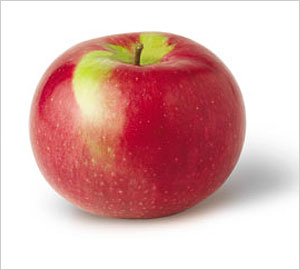
In 1811, John McIntosh found several apple seedlings growing on his farm near Dundela, Ontario. He moved them closer to his house, but only one survived and produced the fruit that became the McIntosh.
Seeds taken from that apple would not produce another McIntosh. Apple seedlings inherit a new mixture of genes from two parents, so each is genetically different. Around 1835, John McIntosh’s son Allan began grafting material from the original tree onto winter hardy apple rootstocks. This allowed the family to make genetically identical copies of its fruiting wood.
The fruiting portion of every McIntosh tree is therefore a vegetative descendant of that original tree. Its roots usually belong to a different apple entirely.
2. Ambrosia appeared in a British Columbia orchard without being planted
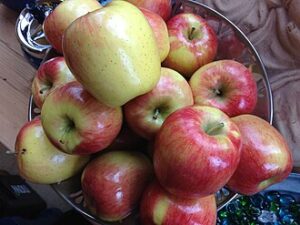
In the early 1990s, Wilfrid and Sally Mennell noticed an unfamiliar apple tree growing among the Jonagold trees in their orchard near Cawston, British Columbia. It was a chance seedling, not a tree they had purchased or deliberately bred.
Orchard workers liked eating its sweet, low acid fruit, which persuaded the Mennells to propagate it. They named it Ambrosia after the food of the Greek gods.
Its precise parentage has never been established. Whatever combination produced it, the original tree was fortunate not to have been removed as an orchard weed.
3. Goodland waited 30 years between selection and release
Goodland began as an open pollinated seedling of Patten Greening at the federal research station in Morden, Manitoba. Open pollinated means the maternal parent was known, but the pollen could have arrived from any compatible apple flowering nearby.
The seedling was selected in 1925 and identified during testing as Morden 354. It was not named and released as Goodland until 1955.
That long wait is not extraordinary in apple breeding. Researchers must watch a seedling through repeated winters and harvests, propagate it onto rootstocks and determine whether its fruit and growth remain dependable.
4. Some apples need only 250 to 300 chilling hours
Apple buds enter dormancy during autumn. Before they can resume normal growth, they have to experience a variety-specific amount of cool weather called the chilling requirement.
The simplest model generally counts every hour between 0 and 7.2 Celsius as one chilling hour.
Anna, an apple bred in Israel, requires only about 250 to 300 chilling hours– just 10 to 13 days. Many traditional apples require considerably more, which limits their usefulness in places with mild winters.
Low chilling requirements are not automatically an advantage in cold regions, though. A low-chill tree may complete dormancy early and respond to a midwinter warm spell, leaving developing buds vulnerable when cold weather returns.
5. Honeycrisp was rescued from the reject pile
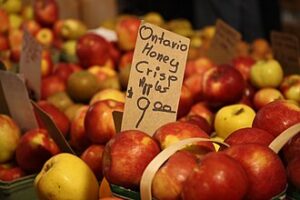
Honeycrisp began as an experimental University of Minnesota seedling known as MN 1711. After the original tree suffered winter injury and its clones performed poorly, the selection was marked for removal.
Apple breeder David Bedford reviewed it in the early 1980s. He noticed that the original tree had been planted in a low, wet part of the orchard, where winter injury could have been because of the location rather than the variety. He gave the remaining trees another chance.
The apple was released as Honeycrisp in 1991. Its exceptionally crisp texture changed what consumers expected from an apple and made it an important parent of later varieties.
6. Some apple varieties are pollen dead ends
Most cultivated apples have two sets of chromosomes. Jonagold has three, making it a triploid. Its irregular chromosome number interferes with pollen formation, so its pollen has very low fertility.
Jonagold can produce fruit when it receives compatible pollen from another apple, but it cannot reliably return the favour. If a gardener wants dependable crops from Jonagold and its companions, two compatible, fertile varieties should flower nearby. A suitable crabapple or a neighbour’s tree may provide one of them.
Mutsu, Gravenstein and Creston are three other triploid apples you may have heard of.
7. Pink Lady is a brand; the apple variety is ‘Cripps Pink’
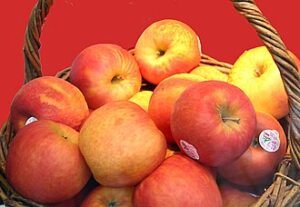
The original apple behind Pink Lady is the cultivar Cripps Pink. Australian breeder John Cripps produced it by crossing Golden Delicious with Lady Williams and selected it during the 1970s.
Pink Lady is a registered brand used for fruit that meets standards for characteristics such as colour, firmness and sugar content. Cripps Pink apples that fail to qualify are still Cripps Pink, but they cannot be marketed under the Pink Lady name.
The cultivar identifies the plant. The trademark identifies the fruit that passed the brand inspection.
8. Arctic Golden has its normal browning response turned down
Why do apples turn brown when cut? Cutting an apple damages its cells and brings phenolic compounds into contact with polyphenol oxidase, commonly called PPO. In the presence of oxygen, this enzyme helps produce the familiar brown colour.
Arctic Golden was developed from Golden Delicious by Okanagan Specialty Fruits in British Columbia. Researchers introduced genetic material that triggers gene silencing, a process that prevents the apple from producing as much PPO. The relevant genes have effectively had their volume turned down.
The modification slows enzymatic browning after the apple is cut or bruised. It does not prevent the fruit from ageing, rotting or being damaged by disease. It is an apple, not a museum specimen.
There are other apples that are naturally slow to brown including Cortland, Envy and Pink Lady.
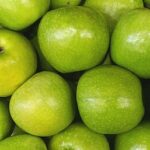
9. Granny Smith arose as a surprise

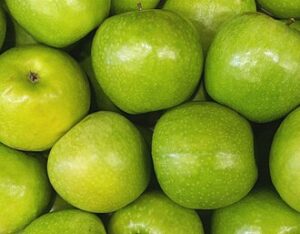
According to the earliest historical account, Maria Ann Smith discovered an unusual seedling growing near a creek on her farm in Eastwood, Australia, in 1868.
Smith recognized that this green fruit was crisp, excellent for cooking and unusually good at keeping. She propagated the tree and sold the apples at a Sydney market. The variety later became known as Granny Smith.
Smith died in 1870, before the apple became widely known. Other growers continued propagating it, eventually selling the variety under the name by which they knew her: Granny Smith.
10. Some apples are red all the way through
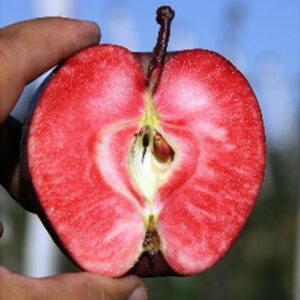
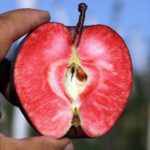
Lucy Glo looks pale yellow from the outside, but cutting it open reveals flesh marbled with pink and red. It was produced by crossing Honeycrisp with Airlie Red Flesh, an older apple carrying the red flesh trait.
Other red fleshed apples include Pink Pearl, Hidden Rose, Scarlet Surprise, Rubaiyat, Grenadine, Weirouge and Baya Marisa.
The colour comes from anthocyanins, the pigments responsible for many red, blue and purple colours in plants. In red fleshed apples, genes regulating anthocyanin production are active inside the fruit rather than principally in its skin.
The intensity and distribution of the colour can vary among apples. That irregularity is part of the effect: every sliced fruit looks as though someone has been experimenting with watercolours.
Images

By: Shauna Dobbie

By: Laurabrager
Source: Wikimedia
Licence:


Sources
The Canadian Encyclopedia: McIntosh Apple. History of the original Ontario seedling and the McIntosh family’s use of grafting.
Ambrosia plant patent. Identifies Ambrosia as a chance seedling discovered in the Mennell orchard in the Similkameen Valley.
Gutiérrez Villamil, D. A., Álvarez Herrera, J. G. and Fischer, G. 2022. Performance of the ‘Anna’ apple in tropical highlands: A review. Revista de Ciencias Agrícolas 39: 123 to 141. Reports a chilling requirement of approximately 250 to 300 hours at or below 7.2 Celsius.
Al Shoffe, Y., Robinson, T., Fazio, G., Follett, E., Clark, M., Luby, J., Bedford, D., Kalcsits, L. and Peck, G. 2025. ‘Honeycrisp’: The challenge of the apple crisp revolution. Fruit Research 5: e039. A peer reviewed account of Honeycrisp’s breeding history, distinctive texture, commercial importance and cultivation problems.
Matsumoto, S. 2014. Apple pollination biology for stable and novel fruit production: Search system for apple cultivar combinations showing incompatibility, semicompatibility and full compatibility based on the S-RNase allele database. International Journal of Agronomy 2014: 138271. Explains apple pollination compatibility and why triploid cultivars such as Jonagold have low pollen viability and cannot serve as effective pollinizers.
Cripps, J. E. L., Richards, L. A. and Mairata, A. M. 1993. ‘Pink Lady’ apple. HortScience 28: 1057. Original cultivar description for the apple now known botanically as Cripps Pink.
Health Canada. 2017. Novel Food Information: Arctic Apple Events GD743 and GS784. Describes the genetic modification used to suppress polyphenol oxidase in Arctic Golden and Arctic Granny apples and summarizes Health Canada’s safety assessment.
The Granny Smith Apple. Sunday Times (Perth, Wa: 1902–1954). 2 November 1924. p. 25. Historical account of origin.
Bouillon, P. et al. 2024. Tracing the colour: Quantitative trait loci analysis reveals new insights into red flesh pigmentation in apple. Horticulture Research 11: uhae171. Examines the genes and anthocyanin pathways controlling red flesh in apples.