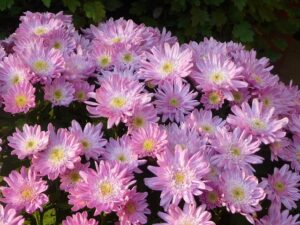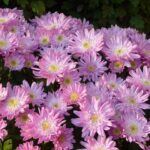
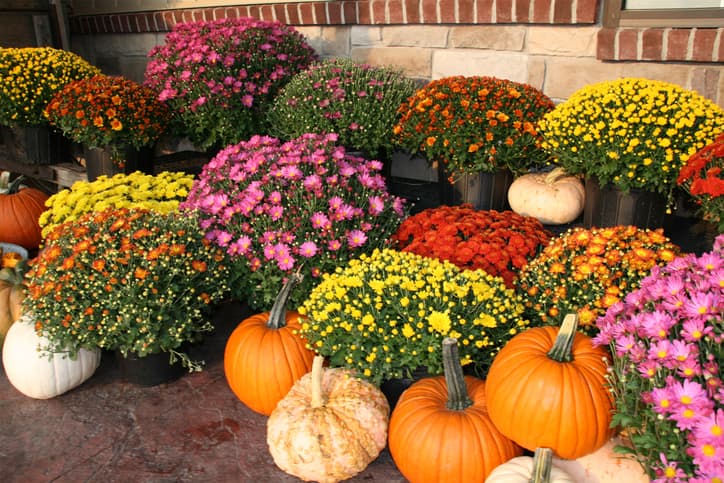
Every grocery store, garden centre and front step seems to acquire potted mums for the fall. They are a kind of autumn decor, like pumpkins that happen to bloom.
Chrysanthemums have a surprisingly distinguished scientific career. They helped botanists work out how plants tell the season, they carry a genome that took decades to untangle, and their travel history spans more than a thousand years.
By the way, there are annuals and perennials in this big family. If you buy them for your long term garden, make sure it is perennial in your area.
1. They measure the night
Chrysanthemums flower when nights grow long enough, which is why they wait for autumn. Researchers studying a wild chrysanthemum found that under long summer days the leaves produce a protein called AFT. It travels to the growing tip and holds back flowering.
Once nights lengthen past a critical point, AFT production drops and flower buds are allowed to form. A mum on a September doorstep is not responding to cooler weather or the arrival of pumpkin spice. It is responding to the fact that, by the time its internal clock checks for light, the sun has already set.
2. Growers can make it October whenever they like
Because the trigger is night length, commercial growers control flowering by controlling the dark. Blackout cloth pulled over the benches creates long nights in midsummer. Lights switched on in the middle of the night break up a long night and keep plants leafy.
The researchers who identified AFT noted that this system is what makes year-round production of chrysanthemums possible. That is how a mum can bloom for Mother’s Day in May, blissfully unaware it has the wrong season.
3. They try to bloom in summer anyway, and fail
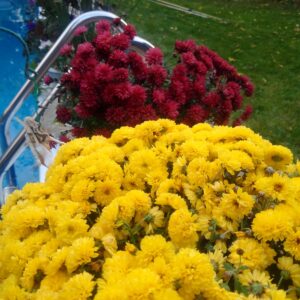
Long days don’t stop a chrysanthemum from trying. When researchers grew 38 commercial cultivars under continuous long days, 36 eventually formed flower buds anyway. None of those buds opened. They stalled as what growers call crown buds, sitting tight at the top of the stem.
The same trap can catch a garden mum in autumn. Light in the middle of the night reads to the plant as a long day, which is exactly how commercial growers keep plants leafy on purpose. A mum planted under a porch light or security light may be getting that same message. If its buds stay tight and green while the neighbour’s are in full colour, check what’s shining on it after dark.
4. They helped find the flowering hormone
In 1936, the Soviet plant physiologist Mikhail Chailakhyan experimented with chrysanthemums and showed that leaves, not buds, detect day length. Something had to carry the message from the leaves to the shoot tip. He named that unknown signal florigen.
Botanists then spent about 70 years looking for it. The answer, confirmed in the mid-2000s, involves a mobile protein produced by a gene called FT. It remains one of the longer waits for a delivery in the history of science.
5. Every "petal" is really a flower
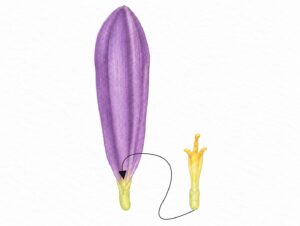
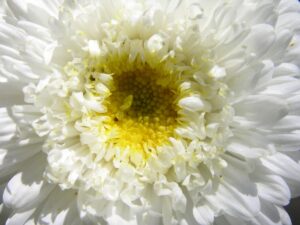
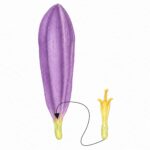
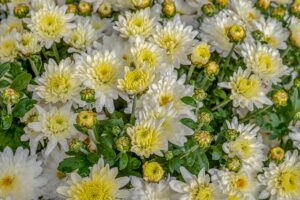
Pull a single “petal” (a ray floret) off a mum and you are holding a complete, tiny flower of its own, with a pistil tucked at its base. It even starts to build male parts, then abandons the project partway through.
Stranger still, each one begins as a ring of five fused petal buds. In the familiar flat shape, the two petals on the upper side stop growing almost immediately and the other three stretch into the strap you see. When all five keep growing together, the result is a tube, which is how quill and spider mums get their look. Spoon types land in between.
A study published this May found two genes that put the brakes on that upper side. When researchers turned them down, flat-petalled mums produced spoons and tubes instead. Breeders have been selecting these shapes for centuries without knowing which dial they were turning.
6. One season wonders
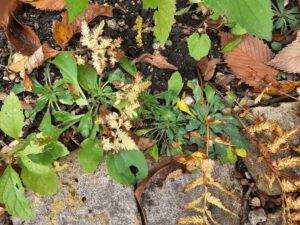
The potted mum from the grocery store in spring and the one bought in full bloom in October are usually florist mums, varieties bred to bloom on cue in a greenhouse rather than to survive outdoors. Whether a mum lasts the winter comes down to its rhizomes, and these types tend to make few of them.
The October pot is the long shot: little time, little reserve and a winter ahead. Enjoy it on the step and compost it with a clear conscience, or plant it and treat any comeback as a bonus.
A general hardiness rating for perennial mums is Zone 5 or 6, but there are some bred in Minnesota and Manitoba that are rated to Zone 3.
7. They reached Europe late
A genomic study published this August traced how cultivated chrysanthemums spread around the world. Chinese cultivars reached Japan in the eighth century, where crossing with Japanese wild species produced a second centre of diversity.
They did not arrive in Germany until 1711, or in France until 1789. The French received chrysanthemums and a revolution in the same year. The study also confirmed the wild Chrysanthemum indicum as one of the key ancestors of today’s varieties.
8. Blue took genetic engineering, but not much
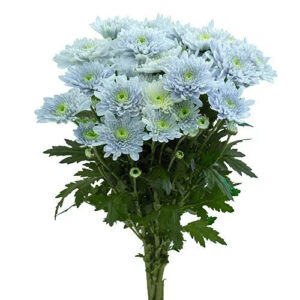
Chrysanthemums come in nearly every colour except blue. They lack the genes needed to make delphinidin, the pigment behind most blue flowers.
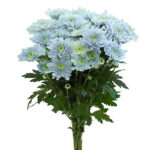
In 2017, Japanese researchers produced the first true blue chrysanthemum by adding just two genes, one from Canterbury bells and one from butterfly pea. The altered pigment turned blue by pairing with colourless compounds the petals already contained. Nature had supplied most of the ingredients and simply forgotten two.
The Japanese company Suntory released a line of blue and violet chrysanthemums called BluOcean that went on sale as cut flowers in Canada and the United States in 2023.
9. Botanists took the name away, then gave it back
Under the strict rules of botanical naming, the genus name Chrysanthemum was tied to a Mediterranean species grown in East Asia as the leafy green shungiku. That left the florist’s mum filed under Dendranthema, a name almost nobody outside a herbarium used.
In 1995, a proposal was made to reassign the name to the Asian species behind garden mums. It was accepted in 1999. The salad green moved to Glebionis, and the florist’s chrysanthemum got its name back. It is one of the rare times gardeners have won an argument with taxonomists.
10. They do not clean the air
The 1989 NASA Clean Air Study included potted chrysanthemums, and they have appeared on air-purifying plant lists ever since. A 2020 review recalculated a dozen chamber studies for conditions in real buildings.
Ordinary ventilation already replaces indoor air so quickly that it would take 10 to 1,000 potted plants per square metre of floor space to match it. At that density, a living room is less a room with plants than a greenhouse with a couch in it.

Chrysanthemums bloom in autumn because they measure the length of the night. That simple trigger lets growers supply them year round, and it helped scientists discover how plants time their flowering. Beneath the familiar potted mum lies one of the most complicated genomes in horticulture and a journey from China to Japan to eighteenth-century Europe.
They won’t purify your air, and they may sulk under a porch light. What they do is flower reliably while most of the garden is winding down, which is plenty.
Images


By Dorothy Dobbie
Used with permission

AI generated illustration


Courtesy of Suntory/ Floragene

By: Dorothy Dobbie
Used with permission
Sources
Cockshull, K. E., and A. M. Kofranek. 1985. “Long-day flower initiation by Chrysanthemum.” HortScience 20: 296–298. Shows that most commercial chrysanthemum cultivars form flower buds even under continuous long days, but those buds fail to open.
Cummings, B. E., and M. S. Waring. 2020. “Potted plants do not improve indoor air quality: a review and analysis of reported VOC removal efficiencies.” Journal of Exposure Science & Environmental Epidemiology 30: 253–261. Recalculates chamber studies of plant air cleaning for real buildings and finds ventilation far outpaces potted plants.
Ding, L., et al. 2026. “The CmYAB1‐CmCUC2 transcriptional module shapes the iconic ray florets in Chrysanthemum morifolium.” New Phytologist 251: 2218–2236. Shows how chrysanthemum ray petals start as a fused ring and identifies two genes that decide whether they grow flat, spoon-shaped or tubular.
Higuchi, Y., et al. 2013. “The gated induction system of a systemic floral inhibitor, antiflorigen, determines obligate short-day flowering in chrysanthemums.” Proceedings of the National Academy of Sciences 110: 17137–17142. Identifies the leaf protein that blocks chrysanthemum flowering under long days and shows how light during the night switches it on.
Noda, N., et al. 2017. “Generation of blue chrysanthemums by anthocyanin B-ring hydroxylation and glucosylation and its coloration mechanism.” Science Advances 3: e1602785. Reports the first true blue chrysanthemum, produced with two introduced genes.
Song, A., et al. 2023. “Analyses of a chromosome-scale genome assembly reveal the origin and evolution of cultivated chrysanthemum.” Nature Communications 14: 2021. Presents a reference genome for the hexaploid cultivated chrysanthemum.
Yuan, C., et al. 2026. “The origin and domestication of modern cultivated Chrysanthemum × morifolium.” Nature Plants 12: 1725–1740. Traces the ancestry of cultivated chrysanthemums and their spread from China to Japan and Europe.
Zeevaart, J. A. D. 2006. “Florigen coming of age after 70 years.” The Plant Cell 18: 1783–1789. Recounts the florigen hypothesis from Chailakhyan’s experiments to the identification of FT.