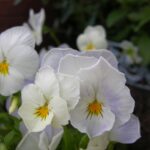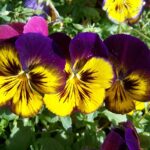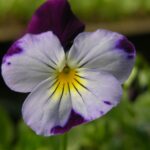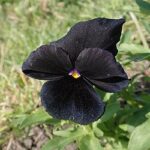
Most bedding plants treat a Canadian spring as a personal insult. Pansies treat it as an invitation. They bloom while the tomatoes are still sulking indoors, shrug off frost, and then, just when everything else hits its stride in July, they wilt dramatically like a Victorian heroine who has been handed the wrong teacup. Understanding why is the key to growing them well.
Why pansies love the cold
Pansies are built for shoulder seasons, and the research explains why. They flower faster as the days get longer, and faster as temperatures rise, but only up to about 22 Celsius. Bright light speeds things along too.
The catch is flower size. As growing temperatures climb, pansy blooms get steadily smaller, a trend that holds all the way from 9 to 31 Celsius. So the long, cool days of May give you big, plentiful flowers. The hot days of July give you small, sad ones and a plant that looks like it needs a lie down.
Starting from seed
Pansy seed wants to be kept cool, since it germinates poorly in the heat. Start seeds in a cool room rather than on top of the fridge, and cover them only lightly. Most gardeners, reasonably, just buy transplants and spend the saved time admiring them.
Planting: spring and fall
Plant in early spring as soon as the soil can be worked. Pansies are frost-hardy, so there is no need to wait for the May long weekend.
Fall planting works too, and late summer to early fall is a fine time to tuck some into containers and beds. Just keep your expectations about winter realistic. In freezing trials, pansies that had never been gradually exposed to cold all died at −15 Celsius, while plants hardened off to the cold survived to −18. The lesson: plants that get a slow, natural cooldown in fall stand a much better chance than greenhouse plants set straight out into a cold snap. On the Prairies, where winter regularly laughs at −18, count any spring survivors as a pleasant surprise.
Soil, pH and black root rot
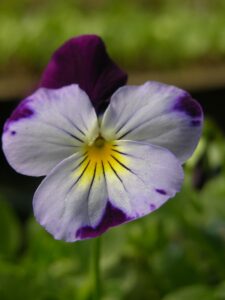
Black root rot, caused by the soil fungus Thielaviopsis basicola (now also called Berkeleyomyces), is the most troublesome disease of pansies in greenhouse production, and it sometimes comes home with nursery plants. Infected plants look stunted, yellowish or purplish, and the roots show dark bands instead of healthy white. Most gardeners who meet it simply decide the plant was a dud. The fungus is less of a problem in slightly acidic conditions.
If your garden soil is on the alkaline side, as many Prairie soils are, grow pansies in containers filled with fresh potting mix. Never reuse soil from a pot where pansies died mysteriously, and don’t overwater. Pansies want to be moist, not marinated.
The summer slump
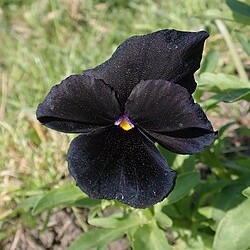
When the heat arrives, you have three options. Give plants afternoon shade and keep them watered to carry them through. Cut back leggy plants by about half and wait for cooler weather in late August. Or pull them without guilt and replace them with something that enjoys July. All three are respectable choices.
Deadheading throughout the season keeps plants producing flowers rather than seed.
Eat them
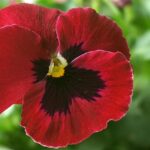
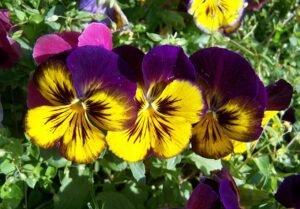
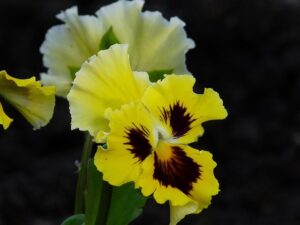
Pansies are one of the few bedding plants you can put on a cake. The flowers have been confirmed non-toxic as food, and colour matters: red, dark red and dark purple blooms carry the most vitamin C, anthocyanins and polyphenols, while white and pale flowers carry the least. Violet and yellow bicolours also beat plain yellow. In other words, the dramatic dark ones are the better snack.
Only eat flowers you grew yourself without pesticides. Nursery transplants may have been treated with products not approved for food crops, so give purchased plants a few weeks of new growth before harvesting.
Need to Know
| Life cycle | Short-lived perennial or biennial, grown as an annual |
| Height and spread | 6 to 9 inches tall, 9 to 12 inches wide |
| Sun | Full sun to part shade; afternoon shade helps in hot spells |
| Water | Evenly moist but never soggy; check containers daily in warm weather |
| Soil | Well-drained, rich in organic matter, slightly acidic (pH 5.5 to 6.5) |
| Planting | Early spring as soon as the soil is workable, or late summer to early fall |
| Bloom time | Spring to early summer, and again in fall |
| Frost tolerance | Survives to about −15 Celsius |
Good to Know
| Plant family | Violaceae (violet family) |
| Native status | Non-native garden hybrid |
| Spacing | 6 to 10 inches apart |
| Starting from seed | Start indoors 10 to 12 weeks before last frost in a cool spot; cover barely, about ⅛ inch |
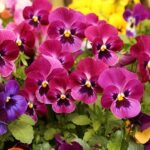
| Bloom colour | Purple, blue, yellow, orange, red, white, near-black and endless bicolours |
| Maintenance | Deadhead; cut back leggy plants in midsummer |
| Deer and rabbit resistance | Sometimes browsed |
| Toxicity | Flowers are edible |
| Pests and diseases | Aphids and slugs; black root rot and other root rots in wet soil |
Images

By: Dorothy Dobbie
Used with permission


By: Dorothy Dobbie
Used with permission
References
Adams SR, Pearson S, Hadley P. 1997. The effects of temperature, photoperiod and light integral on the time to flowering of pansy cv. Universal Violet (Viola × wittrockiana Gams.). Annals of Botany 80(1):107-112. doi:10.1006/anbo.1997.0411
Carpenter WJ, Boucher JF. 1991. Priming improves high-temperature germination of pansy seed. HortScience 26:541-544.
Copes WE, Hendrix FF. 1996. Influence of NO3/NH4 ratio, N, K, and pH on root rot of Viola × wittrockiana caused by Thielaviopsis basicola. Plant Disease 80:879-884. doi:10.1094/PD-80-0879
Kozicka M, Hallmann E. 2023. Identification and quantification of bioactive compounds in organic and conventional edible pansy flowers (Viola × wittrockiana) and their antioxidant activity. Plants 12(6):1264. doi:10.3390/plants12061264
Niu G, Heins RD, Cameron AC, Carlson WH. 2000. Day and night temperatures, daily light integral, and CO2 enrichment affect growth and flower development of pansy (Viola × wittrockiana). Journal of the American Society for Horticultural Science 125(4):436-441.
Oraee A, Tehranifar A, Nezami A, Shoor M. 2018. Effects of drought stress on cold hardiness of non-acclimated viola (Viola × wittrockiana ‘Iona Gold with Blotch’) in controlled conditions. Scientia Horticulturae 238:98-106. doi:10.1016/j.scienta.2018.04.027
Oraee A, et al. 2020. The effects of three levels of irrigation water on the improvement of cold tolerance of acclimated viola. Acta Physiologiae Plantarum 42:111.
Pearson S, Parker A, Adams SR, Hadley P, May DR. 1995. The effects of temperature on the flower size of pansy (Viola × wittrockiana Gams.). Journal of Horticultural Science 70:183-190.
Tamaki M, et al. 2023. Flower colour and antioxidant activity of violas (Viola × wittrockiana) as edible flowers. Journal of Horticultural Science and Biotechnology 98(5):678-684. doi:10.1080/14620316.2023.2170833
Further reading
Extend the Season with Resilient Pansies, Penn State Extension. Practical tips on fall planting, winter mulching and keeping containerized pansies alive through cold snaps.
Growing Pansies, Utah State University Extension. A thorough home-gardener guide to planting, propagation and pests, from a climate with cold winters and hot summers.
Black Root Rot in Pansies, Penn State Extension. How to recognize the disease, what encourages it and how to keep it out of your pots.
Success with Pansies in the Winter Landscape, University of Georgia Extension. Written for professionals, but a good deep dive on bed preparation, fertilizing and freeze protection.